
Introduction
The global tech startup ecosystem is shaping the future of business, innovation, and digital growth across the world. From small software companies to billion-dollar technology firms, startups now play a major role in solving problems, creating jobs, and improving daily life. In recent years, technology has made it easier for entrepreneurs to build products, reach users, and scale faster than ever before. As a result, startup culture is no longer limited to a few countries. It has become truly global.
For beginners, the idea of startups, investors, accelerators, and innovation hubs can feel confusing. Many people hear success stories but do not understand how the ecosystem actually works behind the scenes. This is where a clear explanation becomes important. Understanding the global tech startup ecosystem helps students, founders, marketers, investors, and professionals see how ideas move from concept to company.
This guide is written in simple English for both beginners and intermediate readers. It explains key concepts without using complex language or technical jargon. You will learn what the ecosystem is, why it matters, and how different parts connect with each other. Real-world examples are used to make ideas easy to understand.
Whether you want to launch your own startup, work in the tech industry, or simply stay informed about global trends, this article will give you a strong foundation. By the end, you will clearly understand how the global tech startup ecosystem functions and how you can benefit from it.
What is the Global Tech Startup Ecosystem?
The global tech startup ecosystem is a connected network of people, organizations, resources, and technologies that support the creation and growth of technology-based startups around the world. It includes founders, developers, investors, mentors, incubators, accelerators, universities, governments, and service providers.
At its core, the ecosystem helps turn ideas into real products and services. A startup usually begins with a problem and a proposed solution. The ecosystem provides tools, funding, guidance, and market access to help that solution grow into a sustainable business.
This ecosystem is called “global” because startups are no longer limited by geography. A founder in Asia can raise funds from Europe, hire developers in Africa, and sell products in North America. Technology, especially the internet and cloud platforms, makes this possible.
The global tech startup ecosystem is constantly evolving. New technologies, market demands, and business models reshape how startups operate. Because of this, learning about the ecosystem is an ongoing process rather than a one-time effort.
Why is the Global Tech Startup Ecosystem Important?
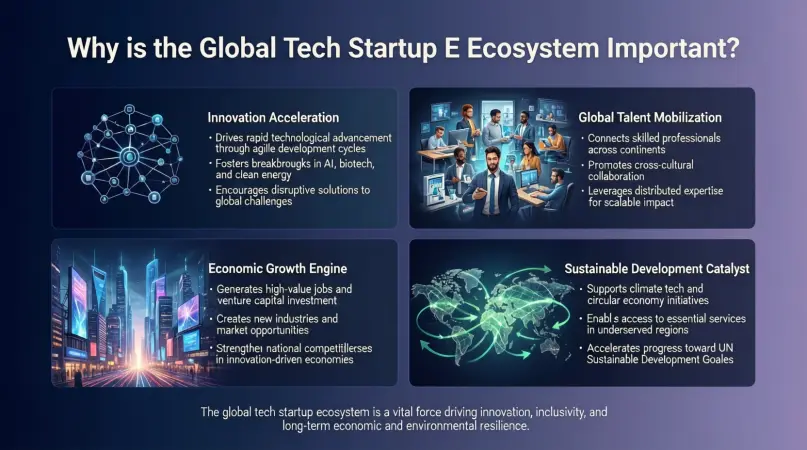
The global tech startup ecosystem is important because it drives innovation, economic growth, and social change. Startups often challenge traditional industries by offering faster, cheaper, and better solutions.
One major reason for its importance is job creation. Startups create millions of jobs worldwide, especially for young professionals and skilled workers. Even failed startups contribute by training people who later join other companies.
Another key factor is innovation. Many technologies we use today, such as mobile apps, digital payments, and online learning platforms, started as small startup ideas. The ecosystem encourages experimentation and risk-taking, which leads to new solutions.
The ecosystem also supports economic balance. Emerging countries can compete globally by building strong tech communities. This reduces dependence on traditional industries and opens new income sources.
Finally, the global tech startup ecosystem promotes collaboration. Founders, investors, and experts from different cultures work together. This exchange of ideas leads to better products and stronger global connections.
Detailed Step-by-Step Guide
Step 1: Idea Generation and Problem Identification
Every startup begins with an idea. This idea usually comes from identifying a real problem that people face. Successful founders observe daily life, industry gaps, or inefficiencies.
A strong idea focuses on solving one clear problem. For example, a startup may notice that small businesses struggle with online payments and create a simple digital solution.
At this stage, research is important. Founders study users, competitors, and existing solutions. This reduces risk and improves the idea.
Step 2: Building the Founding Team
A startup rarely succeeds with only one person. Building a balanced team is critical in the global tech startup ecosystem. A good team usually includes technical, business, and marketing skills.
Trust and shared vision matter more than titles. Many investors prefer strong teams over perfect ideas because teams can adapt.
Remote work has made it easier to form global teams. Founders can collaborate with people from different countries and time zones.
Step 3: Product Development and Testing
Once the team is ready, the next step is building a minimum viable product. This is a basic version of the product with core features.
The goal is to test the idea quickly and gather user feedback. Early users help identify bugs, missing features, and usability issues.
Continuous improvement is key. Startups update products based on real data rather than assumptions.
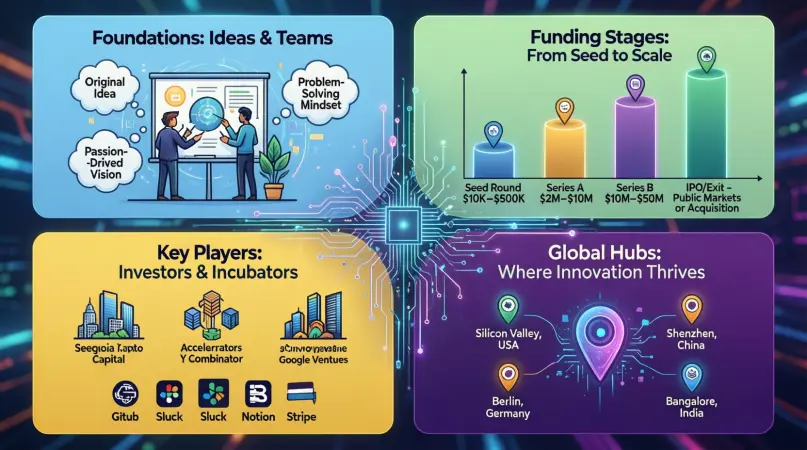
Step 4: Funding and Investment
Funding plays a major role in the global tech startup ecosystem. Startups can use personal savings, angel investors, venture capital, or grants.
Each funding stage has different goals. Early funding focuses on validation, while later funding supports growth and expansion.
Pitching skills are important. Founders must clearly explain their idea, market, and revenue plan.
Step 5: Scaling and Growth
After product validation, startups focus on scaling. This means reaching more users, entering new markets, and increasing revenue.
Scaling requires strong systems, customer support, and marketing strategies. Poor scaling can damage a startup even if the product is good.
Global expansion is common. Technology allows startups to operate internationally with fewer barriers.
Step 6: Long-Term Sustainability
The final step is building a sustainable business. This includes stable revenue, loyal customers, and a strong brand.
Some startups choose acquisition, while others aim for long-term independence. The path depends on vision and market conditions.
In the global tech startup ecosystem, sustainability separates temporary success from lasting impact.
Benefits of the Global Tech Startup Ecosystem
- Encourages innovation and creative problem-solving
- Creates job opportunities worldwide
- Supports economic growth in developing regions
- Enables global collaboration and networking
- Provides faster access to new technologies
- Empowers individuals to become entrepreneurs
- Promotes flexible and modern work cultures
Disadvantages / Risks
- High failure rate for startups
- Financial risks for founders and investors
- Intense competition in crowded markets
- Mental stress and burnout
- Regulatory challenges across countries
- Dependence on external funding
Common Mistakes to Avoid
One common mistake is building a product without real user research. Assumptions often lead to failure. Another issue is poor financial planning, which causes cash flow problems.
Many founders also ignore marketing, believing good products sell themselves. This rarely works. Overexpansion is another risk, where startups grow too fast without proper systems.
Finally, avoiding feedback is a serious mistake. Listening to users and mentors is essential in the global tech startup ecosystem.
FAQs
What makes a startup part of the global tech startup ecosystem?
A startup becomes part of the ecosystem when it uses technology to solve problems and engages with investors, users, and support networks globally.
Do startups need to be tech-focused to join the ecosystem?
Yes, technology is the core element. However, startups in healthcare, education, and finance often use technology as a key tool.
Is the global tech startup ecosystem only for young founders?
No, founders of all ages participate. Experience can be a strong advantage.
How long does it take for a startup to succeed?
There is no fixed timeline. Some succeed quickly, while others take years.
Can startups survive without investors?
Some can, especially bootstrapped startups, but growth may be slower.
Why do many startups fail?
Common reasons include lack of market demand, poor management, and financial issues.
Expert Tips & Bonus Points
Focus on solving real problems, not trends. Build relationships early with mentors and peers. Track data and make decisions based on facts. Stay flexible and ready to adapt.
Learning never stops. The global tech startup ecosystem rewards curiosity, persistence, and continuous improvement.
Conclusion
The global tech startup ecosystem is a powerful force that continues to reshape how businesses are built and how innovation spreads across borders. It brings together ideas, talent, capital, and technology to create solutions that impact millions of lives. For beginners, understanding this ecosystem may seem complex at first, but breaking it into clear steps makes it easier to follow.
This ecosystem is not only about building companies. It is also about learning, collaboration, and growth. Even failed startups contribute valuable experience and skills to the wider community. That is why participation itself holds value.
For aspiring founders, the ecosystem offers opportunities that did not exist before. With the right mindset, research, and support, anyone can take part regardless of location. For professionals and students, it opens doors to new careers and global connections.